
Design policy
Structural member design methods
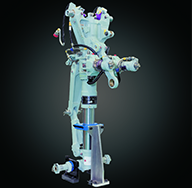
The landing gear must withstand extremely heavy loads to support the aircraft during landing and taxiing, but because they are stored in the aircraft and not used during flight, they must be designed to be as compact and lightweight as possible.
For this reason, the structural components of the landing gear are not designed with redundancy (if one part breaks, other parts will take over and bear the load) or damage tolerance (they can withstand the required load even if some damage occurs to a part), but rather with a safe life design (all parts have the minimum strength required for the aircraft's operational lifespan) to make them as compact and lightweight as possible.
Materials used for structural members
To maximize compactness and weight reduction, metal materials with much higher strength than those used in other industries are used for the legs. For example, the steel called 300M used for the main components of the leg structure has several times the strength (1930 MPa) of high-strength steel used in general industry. In addition to ultra-high-strength steel, high-strength aluminum alloys such as 7050 and 7075 are also used. Aluminum alloys have a specific gravity about one-third that of steel, making them excellent for reducing weight.
These high-strength metal materials are strong and hard, but they are also brittle and susceptible to scratches (prone to fatigue fractures).For this reason, non-destructive testing is carried out on machined structural components to ensure there are no surface defects, and a technique called shot peening is used to improve fatigue strength.
Landing gear shock absorbing capacity
The landing gear has shock absorbers similar to those in automobile suspensions to absorb shocks during landing and ground movement and to keep the load generated within a specified maximum load.
The shock absorber is called a shock strut (or shock absorber), and typically uses a mechanism that combines an air spring and a hydraulic damper. The shock absorber is designed to be able to absorb the impact even when the aircraft lands at a descent speed of 3 meters per second.
Outfitting of piping and wiring to landing gwar
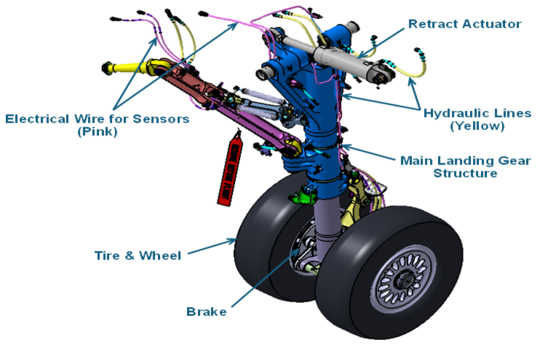
The landing gear is fitted with tires and wheels, landing gear extension actuators for storing and deploying the landing gear into the aircraft, brakes (main landing gear), steering equipment (nose landing gear), etc. The landing gear extension actuators, brakes and steering equipment are operated hydraulically (although on some aircraft models they may be electrically powered), and are connected to the hydraulic source on the aircraft via hydraulic piping. Sensors required for brake control, steering control and landing gear extension/retraction control are also attached to various parts, and are connected to the control box on the aircraft via electrical wiring. In this way, the landing gear is equipped with a large number of hydraulic piping and electrical wiring.
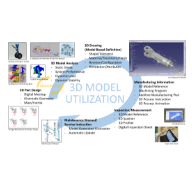
When the landing gear is stowed in the aircraft, the parts are folded to make it compact, but it is necessary to ensure that the piping and wiring are not damaged in the process. For this reason, we use 3D CAD to check the movement while designing the outfitting.
Related links
Links
Contact Us
Contact Us