
MEMS Foundry Service
MEMS Foundry Service
Micro Electro Mechanical Systems (MEMS) are increasingly being used in various fields as an important device technology that supports the enhancement and miniaturization of products.
On the other hand, the design and manufacturing processes are highly complex, and many companies struggle with how to proceed with MEMS implementation or development.
To successfully develop and mass-produce MEMS devices, it is essential to have a comprehensive design that encompasses not only individual technical elements but also the entire process from planning and consideration to design, development, and mass production.
This page provides a summary of fundamental knowledge about MEMS, and then offers comprehensive support from the planning and consideration stages to development and mass production.
We would like to introduce our MEMS foundry service.
If you are considering outsourcing MEMS development, or if you are struggling with how to proceed with design, development, and mass production, please take a look.
MEMS (Micro Electro Mechanical Systems) apply microfabrication technologies cultivated in semiconductor manufacturing to create tiny mechanical structures such as sensors and actuators.
This is a device technology used in combination with electronic circuits.
A key characteristic of MEMS is that, unlike mere electronic components, they can directly handle physical quantities such as motion, force, sound, and pressure.
In recent years, the use of MEMS has advanced in fields such as automobiles, industrial equipment, medical devices, and IoT, and there has been an increase in consideration of introducing or developing MEMS for the purpose of improving product performance and developing new products.
On the other hand, MEMS are highly complex to design and manufacture, and specialized knowledge is essential for their practical application.
This section explains fundamental knowledge that will be useful when considering the introduction or development of MEMS.
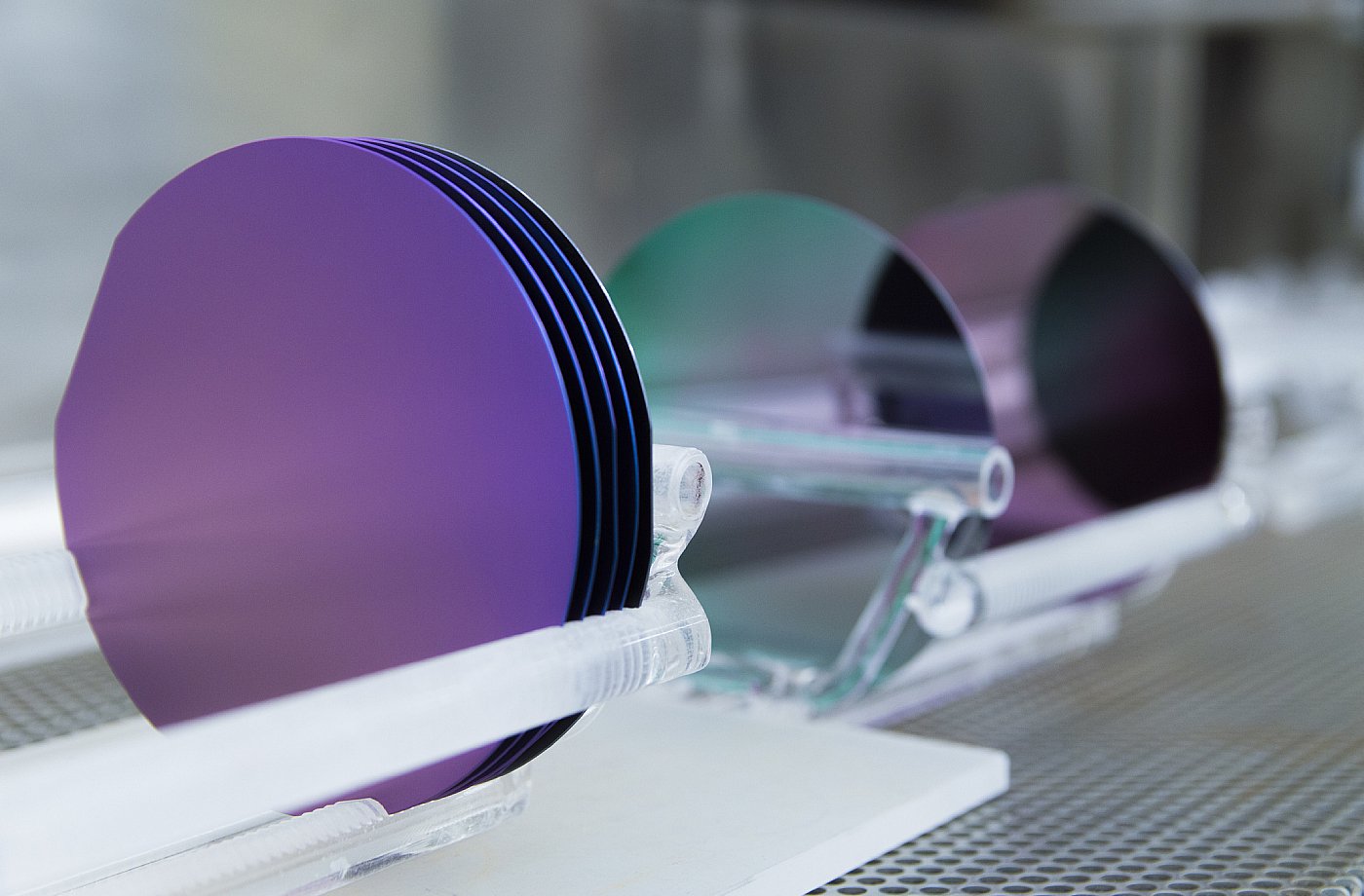
MEMS, like ICs (integrated circuits), use silicon wafers as a base material and are manufactured using semiconductor processes such as photolithography, thin-film deposition, and etching.
Thus, while MEMS are an extension of semiconductor technology, they differ from ICs, which process electronic signals, in that they can form three-dimensional structures and movable parts.
The reason semiconductor technology is widely used in MEMS is that silicon excels not only in electrical properties but also in mechanical strength and processing stability.
With the development of the IC industry, microfabrication technology, mass production processes, and manufacturing equipment have become highly mature.
By leveraging this technological foundation, MEMS has enabled higher precision and functionality in devices, as well as improvements in productivity and cost efficiency.
Some MEMS (Microelectronic Mechanisms) utilize processing technologies and materials other than semiconductor processes, and some have structures without moving parts.
Many of the MEMS devices currently in use are based on semiconductor technology.
While MEMS and ICs share similarities in their manufacturing processes and microfabrication technologies, there are clear differences in their design philosophy and roles.
ICs are designed to process and control electrical signals using electronic circuits such as transistors, resistors, and capacitors.
On the other hand, MEMS are characterized by their three-dimensional structures and internal moving parts, which are used to detect and control physical quantities such as acceleration, pressure, sound, and vibration. The structure, materials, and size vary greatly depending on the application, and even within the same MEMS category, the design can differ significantly. If ICs are the "brain" that handles information processing, then MEMS are equivalent to the "sensory organs" that capture changes in the external environment.
Due to these differences, in MEMS, structural design, material selection, process conditions, and packaging all directly impact performance, making it impossible to apply the same design and development methods used for ICs. Therefore, MEMS development requires a dedicated development approach that considers prototyping and mass production from the initial design stage, and a support system that considers the entire process from design to mass production is crucial.
Because MEMS are "small machines," multiple operating principles are used depending on the application.
One of the most representative methods is electrostatic MEMS, which generates motion by applying a voltage between tiny electrodes.
It has low power consumption and is suitable for miniaturization, so it is used in acceleration sensors and gyroscopes, among other applications.
On the other hand, piezoelectric MEMS, which utilize piezoelectric materials that can convert force and vibration into electrical signals and electrical signals into physical motion, are also widely used. While they offer high sensitivity and fast response, material properties and film deposition quality greatly affect their performance.
Thus, the operating principles of MEMS are closely related to microstructure, material properties, and manufacturing processes, and even slight design differences or variations in process conditions can have a significant impact on performance and yield. Therefore, in MEMS development, not only is an understanding of the principles essential, but optimization that considers everything from design to prototyping and mass production is also indispensable.
At our company, we provide optimal MEMS support tailored to each phase, from the conceptual stage to mass production of MEMS devices.
Our strength lies in providing highly practical development support that goes beyond simple development outsourcing, encompassing everything from design philosophy to process selection.
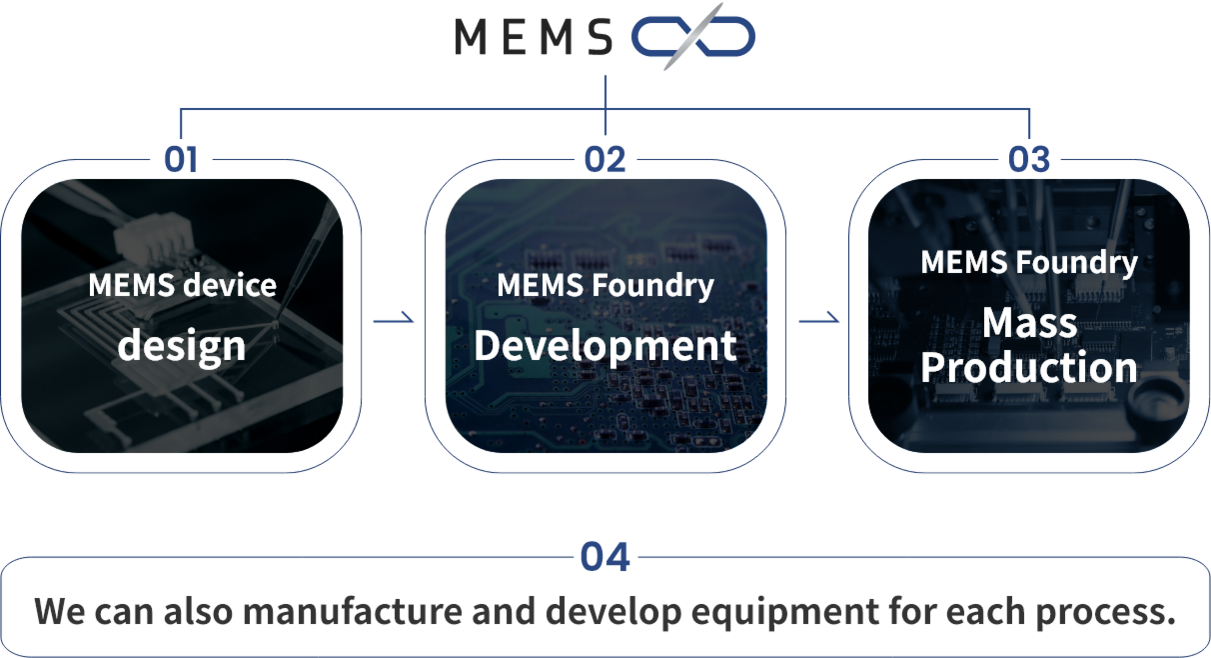
Our company possesses development and product deployment technologies covering all stages of MEMS, from device design to MEMS foundry development and mass production.
This allows our customers to efficiently develop their projects and enables us to provide one-stop manufacturing, which is our greatest strength.
Having world-class development experience and high levels of expertise and knowledge in MEMS, we can handle everything from the initial development stage to the final mass production process.
We will provide total support at every stage.
| Comparison table for
service areas
between our company and other companies |
MEMS design | MEMS Prototyping | Volume production | ||
|---|---|---|---|---|---|
| Structure | Process | 6 inches or less | Over 6 inches | ||
| Design development service provider |
|||||
| MEMS Foundry [From concept verification] [Suitable for small-batch production] |
|||||
| MEMS Foundry [Suitable for mass production] |
|||||
 |
|||||
In the early stages of MEMS development, device structure, operating principle, and material selection significantly impact final performance. Based on our clients' requirements, we design devices with a focus on achieving high-performance MEMS. We can provide comprehensive support from requirements definition to simulation and structural proposals.
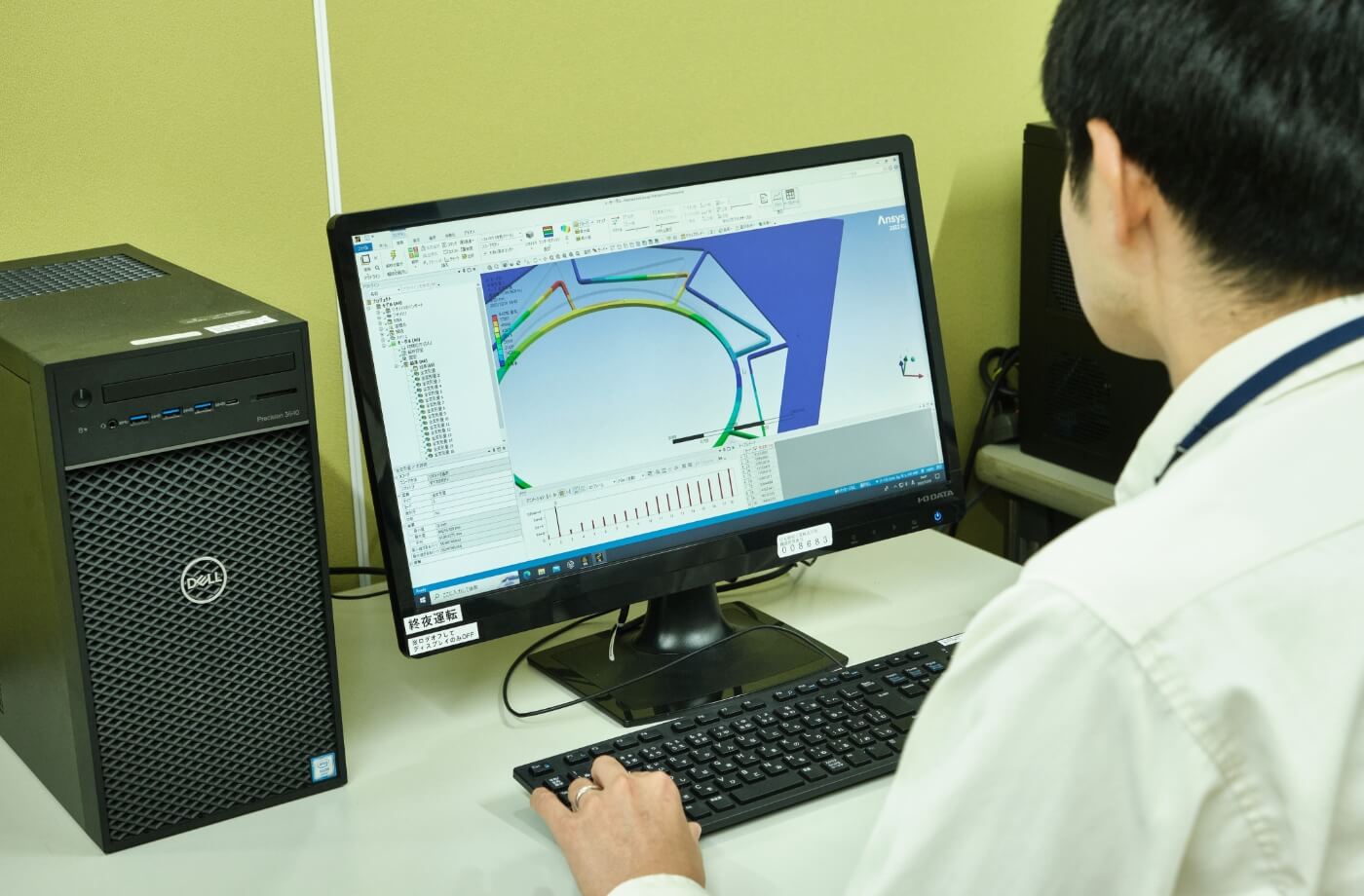
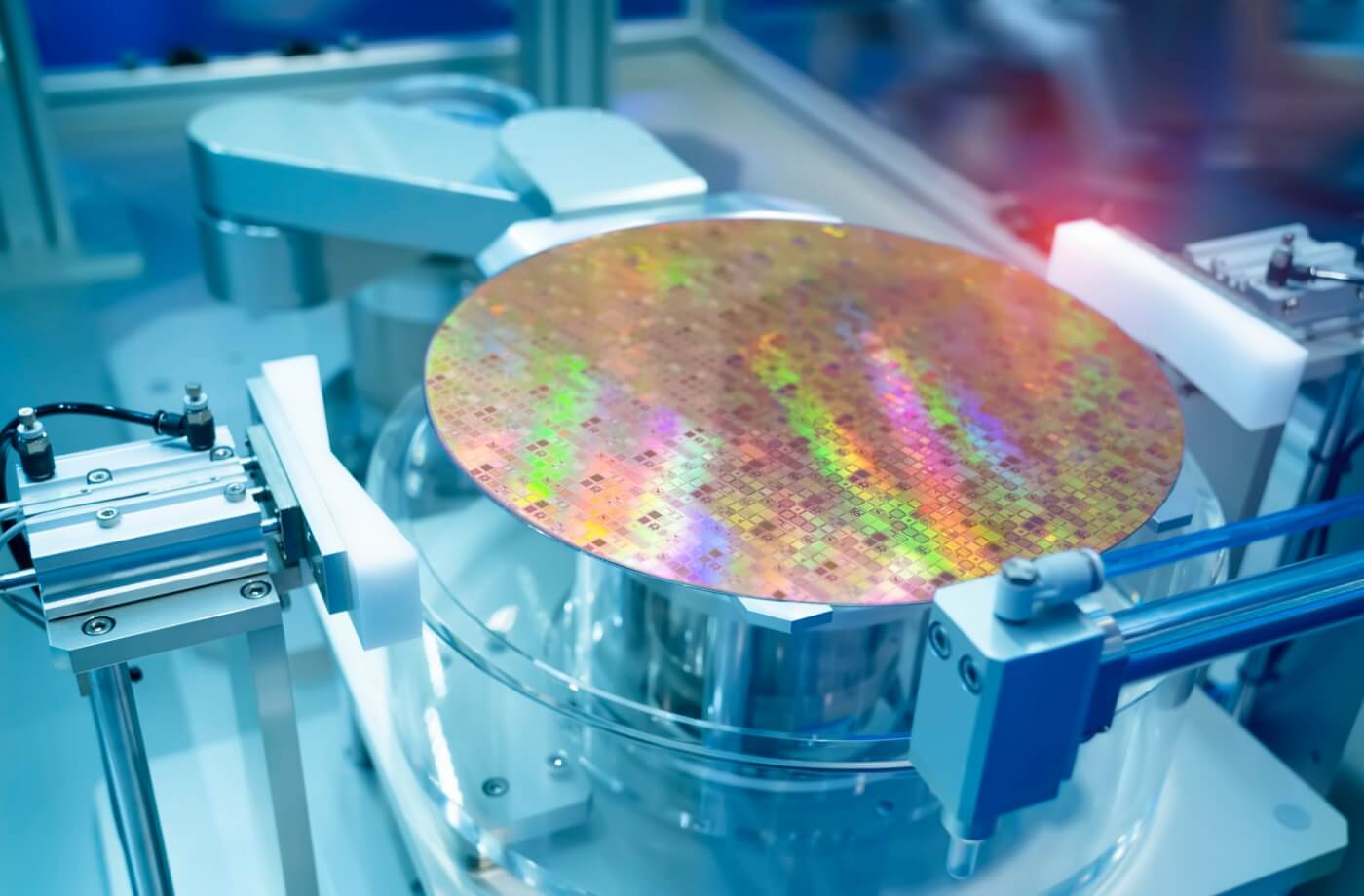
To prototype and evaluate designed MEMS devices, we provide a MEMS foundry development environment capable of handling small-scale prototyping. We flexibly respond to needs such as "We want to outsource MEMS development" or "We want to try new materials and new processes," and support process development toward practical application.
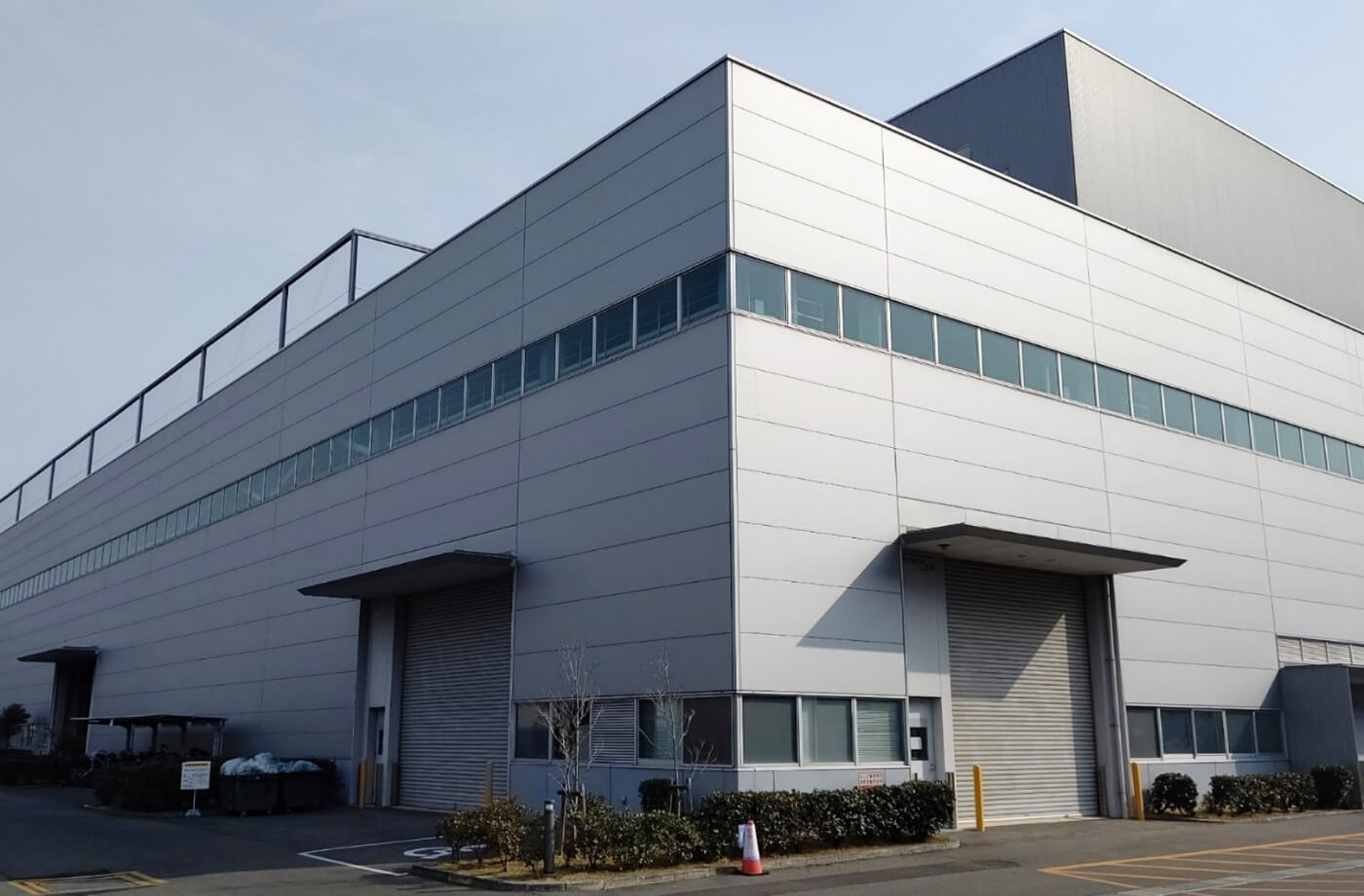
After development is complete, we will support the establishment of a stable mass production system by optimizing processes and developing equipment with mass production in mind. Through mass production design that takes cost, yield, and productivity into consideration, we aim to realize MEMS products with stable quality and mass producibility.

In MEMS implementation and development, challenges such as "the design is viable but doesn't lead to mass production" and "difficulty in selecting a development outsourcing partner" tend to become apparent.
Our company has established a one-stop MEMS support system that can handle all aspects of MEMS design, prototyping, and mass production.
Leveraging our world-class track record in technological development and high level of expertise, we provide comprehensive MEMS support from initial consideration to mass production launch.
Furthermore, we have established a system that takes into account the quality, reproducibility, and stable supply required in the mass production phase.
Please feel free to contact us to discuss your current situation and the stage of your considerations.

 Contact us